Pyuika
The Deer KingPyuika, called flying deer, are wild deer whose lives resist the simple categories of livestock, mount, and political resource. Their bonds with people can endure for life, but they require specialized care and room to roam; efforts to breed and confine them without understanding their habits bring hardship to the herders and danger to the animals. Through Van’s knowledge of them, the narrative makes animal behavior a practical form of expertise—and a measure of the costs of imperial rule.
Identity and Distinctive Habits
Pyuika are physically imposing animals as well as difficult ones to manage. Van remembers seeing a buck standing among dark trees, its antlers rising like flames; the animal’s wavering appearance seemed almost to vanish. The image joins their wildness to their beauty, while the practical scenes of herding show that neither quality makes them easy to control.
Their temperament is not simply skittishness. Once attached, a pyuika remembers a friend and can become lonely when separated. Butting is a sign of affection: Tsupi’s repeated nudges had shown that she had bonded with the young man who cared for her. When she was lost in the woods, Van understood that she was far from home and without other pyuika nearby. In ordinary circumstances she would have returned when the scent of an ossam faded, but the autumn mating season had drawn her away.
Pyuika are grazers, yet their feeding and movement differ from those of reindeer. They eat a wide range of plants, including buds, leaves, and grasses, which regrow quickly enough for herders to revisit grazing places seasonally. Reindeer lichens, by contrast, take years to recover after being eaten, so reindeer herders must move their winter camps among different sites. A practice that suits one herd cannot simply be transferred to the other.
Bonding, Training, and Breeding
Pyuika remain wild when first encountered as adults; their lasting relationship with people begins early. In the Toga Mountains, boys accompanied adult herders in the forest and learned the animals’ habits as the herd roamed. Fawns exposed to human scent from birth could be carefully bonded and trained, and the connection endured for life. A bonded pyuika could respond to its rider’s whistle. This was not a quick technique for taming ordinary livestock but knowledge accumulated through daily observation across generations.
Pyuika usually bear twins. The fawn chosen for training is the larger, stronger one, which is separated from its mother and accustomed to people; Van remembers his father’s rule as a singsong line: “The weak one to the mother, the strong one to me.” The choice turns training into a deliberate intervention in the family group, with the remaining fawn left with its mother.
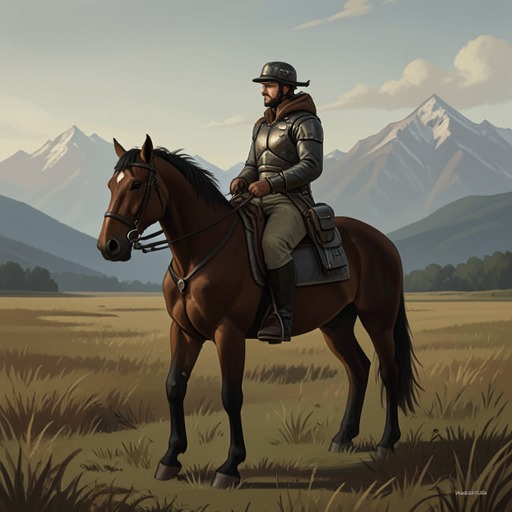
Both sexes can be trained as mounts, but bucks become uncontrollable during the mating season. Those selected for riding must therefore be gelded before maturity. Herders cannot simply take every strong male: removing too many would weaken the next generation, so they must consider the condition of the whole herd when deciding how many fawns to train. Geldings retain their antlers in spring, unlike other bucks, and have less muscular strength, but their stamina is greater because they expend no energy mating. They are also more obedient. Producing a useful mount thus depends on choices made early and balanced against the herd’s future.
Pyuika can interbreed with elk. In autumn, a bull elk’s scent can bring a doe into heat and send her searching through the forest; Tsupi’s escape follows this seasonal pull. Van finds her by reading tracks and scent, and later explains that she will bear an elk’s young the following spring. The calf may be very strong, although the birth is difficult. Van’s clansmen sometimes mate pyuika and elk deliberately to breed larger stock, making breeding a practiced strategy rather than an accidental possibility.
Herding Knowledge and Imperial Policy
Pyuika are poorly suited to being treated as ordinary enclosed livestock. Their herds are broad and loosely defined, with the clearest social unit being a doe and her fawns. They migrate seasonally and follow habitual routes, but their relatively narrow range and varied diet distinguish them from reindeer. Herders can influence where they travel by planting mohoki, a lichen that grows on old trees and that pyuika avoid. Braided into ropes and placed around a fence, it can keep them from entering or leaving an enclosure; planted strategically along familiar routes, it can redirect their movement.
This knowledge matters because confinement without it can fail in two different ways. A pyuika may leap out of a pen, or, if a fence is too high to escape, decline inside it. They can be penned at night when wolves are abroad, but are better allowed to roam during the day. When black beasts attack, the animals panic in the enclosure, and the same mohoki that confuses pyuika also appears to disorient their attackers, which circle the pen rather than approach directly. The lichen is therefore more than a herding aid: its scent affects the encounter between animals, predators, and people.
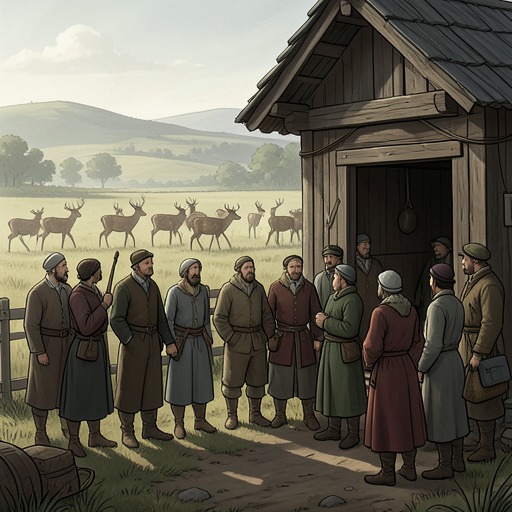
Zolian policy treats the distinction between pyuika and familiar domestic animals as negligible. Near the end of the year before last, northern families were told that raising pyuika instead of reindeer would reduce their taxes. People bought animals from Toga in the hope of benefiting from the cut, only to discover that the high-spirited deer were difficult to handle. The Okuba, a people once like the Gansa in their lives as pyuika herders and nomads, had surrendered to Zol earlier and become scattered serfs. Some Okuba near Toga were ordered to supply pyuika to the Zolians. Van’s people had joked that the attempt to ride them would fail, believing that pyuika could not be raised into a mounted force in a few years; the policy nevertheless continued.
The Oki families who bought pyuika faced the consequences of that mistake. Okuba traders who sold animals to them apparently did not explain the use of mohoki. Van suspects the omission may have been deliberate resistance to Zolian demands, but it is the buyers, not the soldiers, who stand to suffer: they have gone into debt and sold reindeer to finance the new herds, and failure to breed pyuika means heavy taxation. Successful breeding, meanwhile, offers the soldiers a small windfall. A political maneuver framed as an incentive thus shifts the risk onto families with little room to absorb it.
Van’s Intervention and the Limits of Use
Van’s knowledge turns practical when he finds Tsupi and returns her to the young man who had lost her. He calls her with a tongue-clucking sound and explains that she will respond to it; the young man had been told by the Okuba seller to call her by name. Van also tells him about the coming elk calf. The reunion reveals how an apparently minor gesture can depend on knowledge unavailable to a herder taught to treat a pyuika as merely another deer.
The same knowledge shapes Van’s advice to the Oki. When spring arrives, he persuades the men to let the pyuika roam freely rather than lead them after the migrating reindeer. The men fear the animals may not return, but confinement and forced travel have already worked against successful breeding. Because the calving place is usually the same, Van can help locate a doe without keeping her under restraint. His confidence rests on the animals’ limited range and recurring patterns, as well as on observation learned from childhood in the Toga Mountains.
The seasonal schedules of the two herds create a further problem: reindeer move to summer pasture when pyuika are due to calve. The reindeer cannot remain in their winter ground, where summer brings swarms of horseflies and mosquitoes and scant grass; coastal winds at the summer pastures help drive the pests away. The year before, when the pyuika had borne no young, the family simply tied them to a rope and led them along. Van suspects that forcing them into this unnatural rhythm contributed to their failure to breed. The families respond by arranging for some young men to remain and learn pyuika husbandry while the others take the reindeer to summer pasture.
Van’s concern is not limited to making the herd economically viable. Remembering his father’s warning that riders use pyuika for their own ends, he recognizes that the animals were brought to this foreign land without a choice, whereas he left his own homeland freely. He dislikes the prospect of Zolian warriors riding them, but refuses to make that injury the animals’ burden. Human suffering under conquest and taxation is real, yet turning pyuika into a weapon would not undo it; Van resolves instead to relieve the suffering of the animals and people immediately before him.
Narrative Significance
Pyuika are not interchangeable mounts. In the Toga Mountains, they are precious companions raised specifically for riding, while reindeer provide milk, hides, meat, bones, transport, and a more comprehensive livelihood. The contrast explains why Van’s community invests generations in specialized pyuika knowledge, whereas Ohma initially judges reindeer more useful and easier to raise. As the Oki men learn what Van knows, they begin to see the animals differently—not as a failed substitute for reindeer but as creatures with their own needs and possibilities.
That difference also exposes the limits of Zolian expertise. Commanders assume that pyuika can be bred like horses, but producing suitable mounts requires early selection, gelding, careful control of breeding numbers, and time. Their military usefulness cannot be manufactured at the pace of a tax order. The animals’ habits frustrate a regime that sees herds as units to be redirected toward revenue and warfare.
Yet the narrative does not make local knowledge an uncomplicated claim of ownership. Van’s father’s saying acknowledges the self-deception in a culture that celebrates its riders while using the animals for human purposes. Van’s answer is not to pretend that this use is harmless, but to accept a responsibility to reduce suffering. Pyuika’s bonds, migrations, feeding, and fear remain consequential in their own right: understanding them is necessary not only to make them serve people, but also to recognize when human plans are imposing costs they should not have to bear.